
The European Union’s Artificial Intelligence Act (AI Act), a landmark piece of legislation, is set to fundamentally reshape the technological landscape across various industries. While much of the focus has been on generative AI or high-profile public security applications, one quieter but impactful shift is brewing in the realm of infrastructure management: the evolution of people counting solutions.
For years, the people counting market has been dominated by camera-based devices that leverage embedded AI for superior accuracy in detecting and tracking foot traffic. However, the AI Act’s stringent requirements for digital trust and fundamental rights are poised to disrupt this status quo, creating a massive, and financially compelling, market transition toward non-camera-based alternatives. As detailed in the article Digital Trust in IoT and Smart Buildings (1), trust is no longer a „soft issue“ but a strategic imperative, a new currency in the digital world. This imperative makes inherently private sensor technology an industry prerequisite.
The Pre-Regulation Forecast made old: A Video-Centric Market
To understand the scale of the impending change, one must look at the market trajectory before the full effect of the AI Act. Pre-2024 forecasts projected a clear path to dominance for video-based (camera/AI) technologies, driven by their high accuracy (often cited above 95%) and integration with modern analytics platforms.
Market analysis estimated the global People Counting System Market to reach over $2.67 billion by 2030 (2), with video-based demographics expected to record the highest Compound Annual Growth Rate (CAGR) among technologies (3). The market saw people counting as a „new megatrend driving the next wave of IoT“ (5), (read more).
The EU AI Act will render these forecasts obsolete. The legal and financial burden it places on camera-based AI systems will create a „wave of switch,“ dramatically accelerating the adoption of inherently privacy-compliant technologies.
The Compliance Cliff: Why Camera-Based AI is at Risk
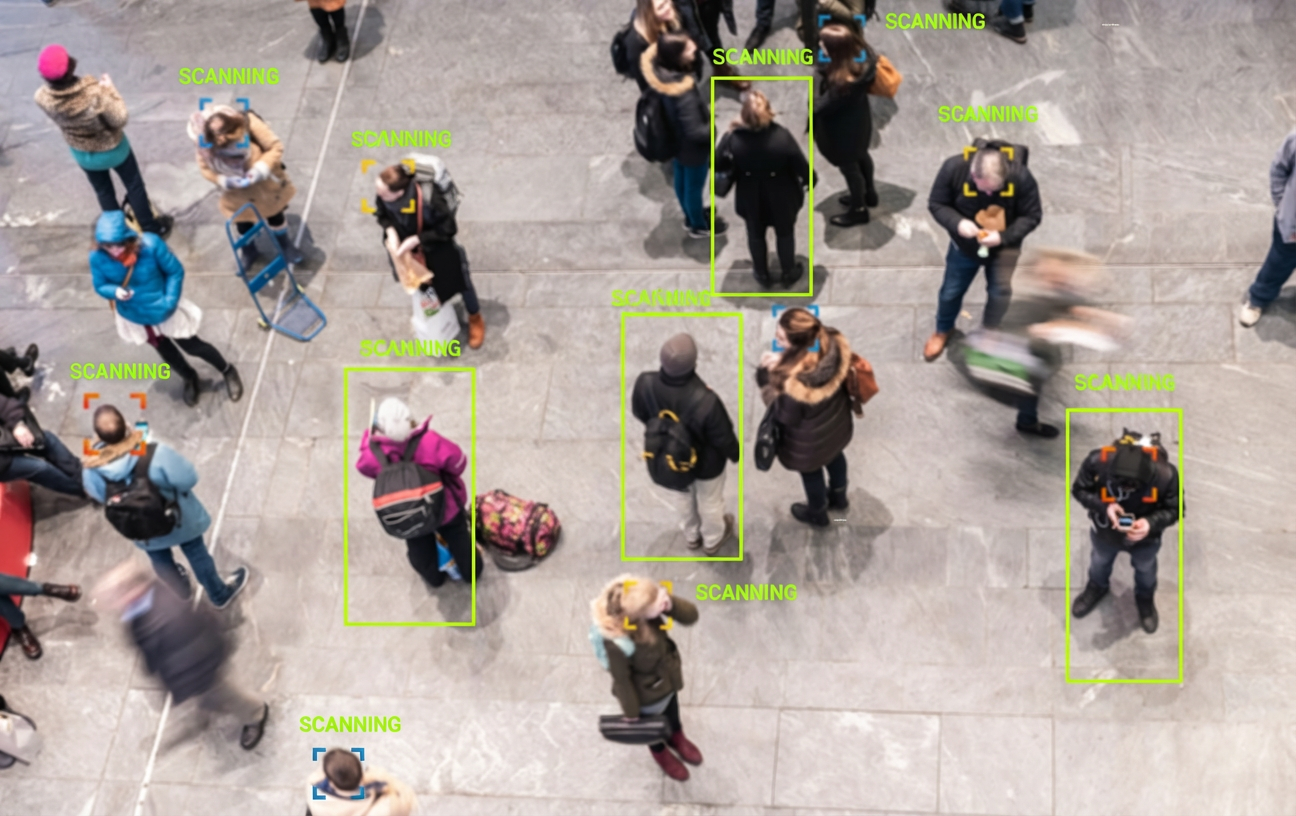
The core of the issue lies in the AI Act’s risk-based framework, which classifies AI systems based on their potential to harm fundamental rights. Many AI-driven camera-based people counters will fall into the ‚High-Risk‚ category, particularly if their underlying system is capable of:
- Remote Biometric Identification: Even if a system is intended only for counting, its capacity to capture and process personal data (like facial features or gait) brings it under intense scrutiny. The Act includes absolute prohibitions on the untargeted scraping of facial images from the internet or CCTV footage, making the use of raw video feeds for training and operation extremely precarious.
- Strict Conformity Assessment: High-Risk systems must undergo a rigorous conformity assessment (a mandatory testing and certification process) and adhere to a host of obligations, including implementing a quality management system, maintaining extensive documentation, and ensuring data governance.
Essentially, the core concern is straightforward: AI’s capacity for self-evolution means it could become „unpredictable“ and even „uncontrollable“ in the future.
The Financial Burden of Certification
The cost of complying with the ‚High-Risk‘ classification is a critical factor driving the market switch. Compliance is not a one-time setup; it requires continuous auditing, maintenance, and expert personnel.
- Projected Costs: Early impact assessments estimate that an EU-based Small and Medium Enterprise (SME) that deploys a single high-risk AI system could incur total compliance costs of up to €400,000 (4).
- Price Hike: For a competitive people counting device, adding a portion of this multi-hundred-thousand-euro compliance and certification cost to the product price is untenable. The price of each compliant camera-based device will need to rise considerably, rendering them uncompetitive against simpler, non-camera alternatives.
The Rise of Non-Camera Solutions: Privacy by Design Wins
This regulatory pressure creates a clear pathway for non-camera-based devices that are „GDPR compliant by design,“ eliminating the risk and cost associated with high-risk classification. Solutions that rely on depth or thermal data inherently cannot capture personal biometric identifiers.
Companies like Terabee have positioned themselves at the forefront of this wave. Their People Counting solutions, branded as FLOW and OCCUPANCY, use advanced Time-of-Flight (ToF) LiDAR technology and low-pixel count thermal imaging, which are explicitly marketed as „GDPR compliant by design“.
- Inherent Privacy: ToF and similar depth and thermal sensors collect non-intrusive depth image data, aka a 3D map of the space, which means that „personal identity can never be captured„, mitigating the AI Act’s most severe privacy concerns at the source. This embodies the „Privacy by Design“ principle mandated by GDPR Article 25.
- Dual Utility: This approach proves that utility and privacy are not trade-offs, rejecting the „either-or“ model for a positive-sum outcome. It delivers accurate, real-time anonymous data needed for smart systems, such as calculating energy per person (7), the key metric the future demands, allowing for massive energy savings and combatting the „psychology of waste“ in buildings (6).
The market is already signaling this shift. One forecast notes that the people counting market size tied to ToF (depth) sensors is projected to eclipse infrared revenues before 2030 (2), driven by falling component costs and, crucially, privacy laws that favor non-imaging depth measurement.
Conclusion: A Future of Compliant Infrastructure
The EU AI Act is not merely a legal hurdle, it is a fundamental market catalyst. It is forcing a clear distinction between ‚High-Risk‘ camera-based AI, burdened by staggering compliance costs and legal ambiguity, and ‚Compliant-by-Design‘ non-camera technologies.
The forecasted domination of camera-based people counting will be curtailed as infrastructure managers, smart city planners, and retailers opt for the lower risk, lower cost, and inherently private solution offered by depth (LiDAR/ToF) and thermal imaging. The future of accurate, digital people counting in European infrastructures will be one where compliance is baked into the sensor technology itself, not patched on with expensive software and certification.

The Author: Dr. Max Ruffo is a visionary technology leader with over two decades of experience at the forefront of industrial innovation, having pioneered the introduction of 3D printing, civil drones, autonomous mobile robots and LiDAR sensors. Today, Max is dedicated to a long-term mission of building a better world by championing green buildings and net-zero communities.
References and Links
(1): Terabee: Digital Trust in IoT and Smart Buildings – How to Build Confidence in the Connected World
(2): Mordor Intelligence: People Counting System Market – Size & Analysis 2025-2030 (Data on Video, ToF, and Infrared segment growth).
(3): SNS Insider: People Counting System Market Share & Growth Report 2032 (Data on Video-based CAGR and market size).
(4): Center for Data Innovation (CDI): Artificial Intelligence Act Impact Assessment (Compliance cost estimates for SMEs with High-Risk AI).
(5): Terabee: People Counting is the New Megatrend Driving the Next Wave of IoT
(6): Terabee: The Psychology of Waste: Why We See the Light, But Not the Air
(7): Terabee: Why Energy Per Person is the Metric the Future Demands