
The year 2025 has marked a pivotal moment in the discourse surrounding the Internet of Things (IoT) and networking. A discernible and significant shift has emerged in academic journals, industry publications, and technological whitepapers, highlighting a burgeoning emphasis on two critical areas: space management and energy savings within the built environment. This profound reorientation strongly suggests a global awakening to a new vision for urban infrastructure and a pressing problem that demands immediate and innovative solutions.
This evolving landscape is further corroborated by observable trends in public interest and market demand. Google search queries and general inquiries from both consumers and businesses are increasingly converging on the term „people counting.“ This surge in interest underscores a growing recognition of the value in understanding human presence and movement for optimizing various aspects of building operations. In response to this shifting demand, numerous IoT networking providers, who previously focused on more generalized applications like home automation and ambient air quality management, have strategically pivoted their core offerings. Their renewed and sharpened focus is now squarely aimed at enhancing both the efficiency of space utilization and the conservation of energy through the implementation of „Smarter Buildings“ initiatives.
From Air Quality to People Counting
For years, the Internet of Things (IoT) narrative was dominated by environmental monitoring, specifically, Air Quality Monitoring (AQM). Low-power, long-range networks like LoRa and Sigfox found their perfect use case in scattered, low-data-rate sensors checking temperature, humidity, and CO2. It was a crucial, foundational step. Today, the future of massive-scale, high-value IoT is shifting to a new, more dynamic sensor type: People Counting and Occupancy Monitoring.
This isn’t just a minor application; it’s a profound market shift, driven by a convergence of technological maturity, critical business needs, and a new demand for real-time spatial intelligence.

Quantifiable Momentum: The Market Explosion
The most compelling argument for a „megatrend“ lies in the financial trajectory. People counting systems are not just growing; they are expanding their addressable market across multiple industries, directly indicating a massive surge in demand for this IoT solution.
Recent industry analysis forecasts staggering growth for the People Counting System market:
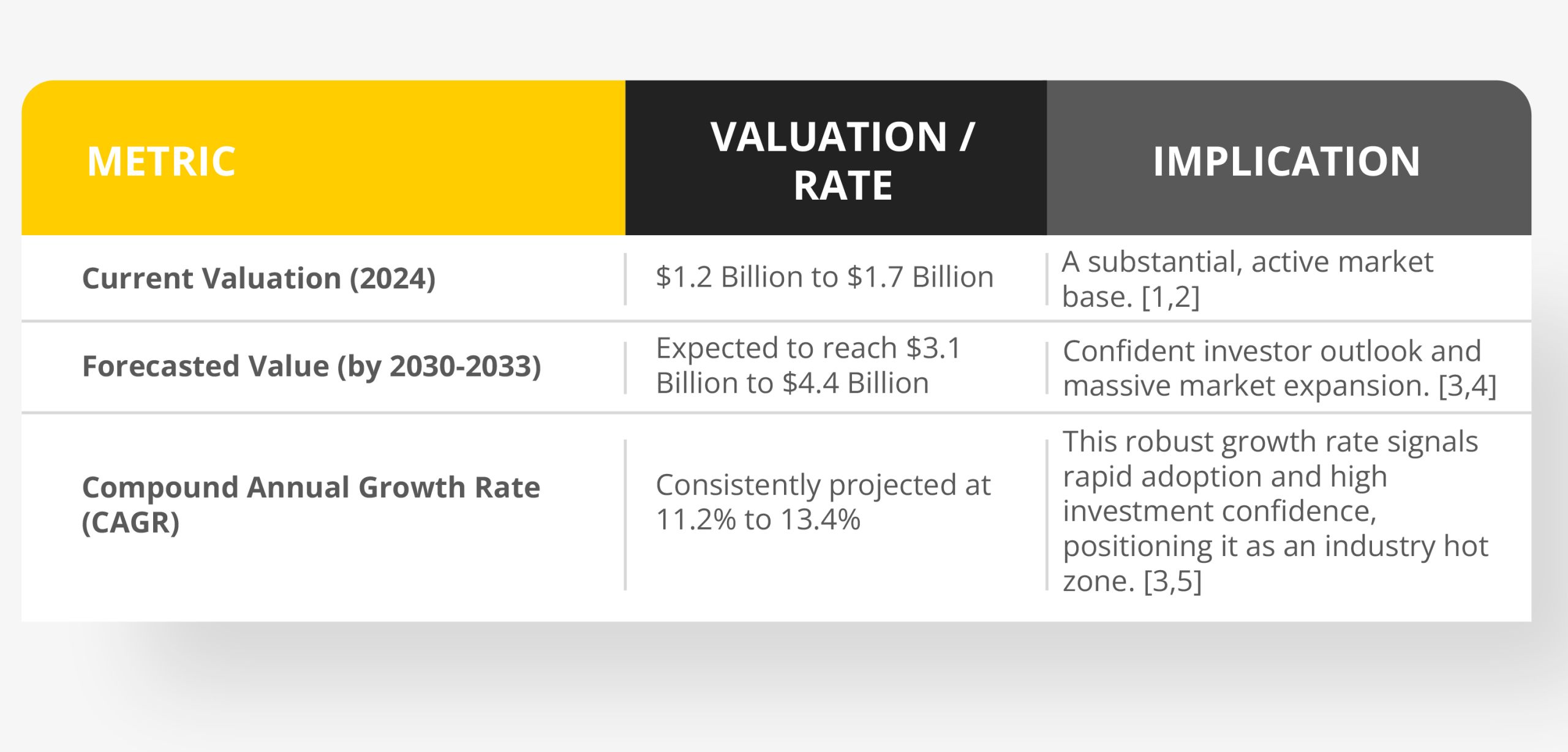
The consistent double-digit CAGR demonstrates that while the initial IoT phase was about proving network capability (like with low-data Air Quality), the current phase is focused on implementing high-value applications that offer immediate return on investment, which People Counting delivers in spades.
II. The Value Shift: From Compliance to Commerce
The core difference between the old and new waves of IoT lies in the value proposition.
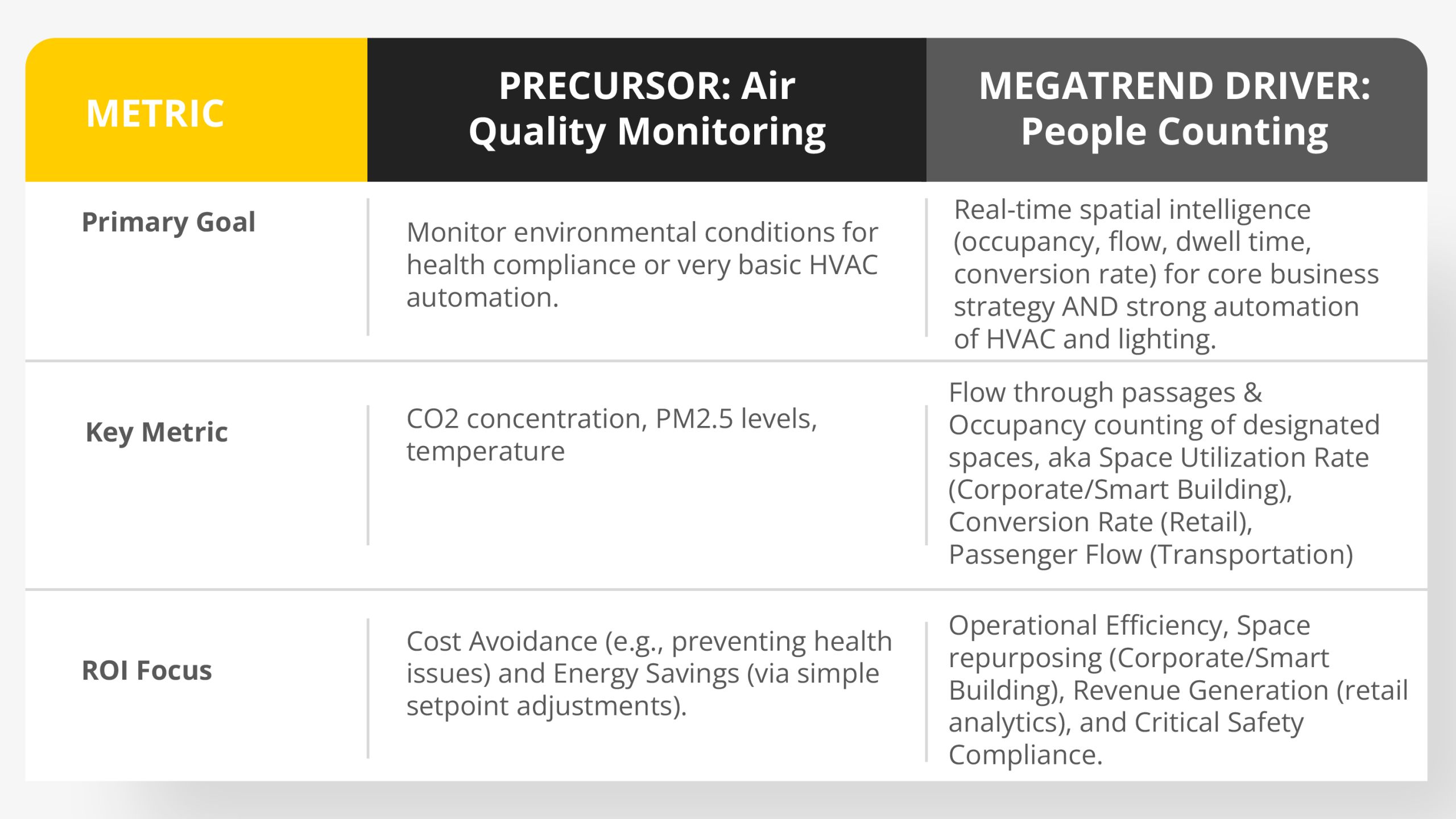
Accurate People Counting systems provide actionable insights that directly impact a company’s bottom line, a far more compelling driver for capital expenditure than simple environmental compliance.
The Technological Maturity
The complexity of accurate People Counting has driven innovation across the sensor ecosystem, necessitating a far more sophisticated IoT stack than was required for basic Air Quality Monitoring.
- AI & Edge Computing: The shift from simple infrared beams to 2D and 3D Video-Based Technology is critical. This requires AI models and machine learning or human made complex algorithms running on the edge device to ensure high accuracy (∼95%) in complex, crowded environments [5]. This AI-on-the-Edge deployment is now a primary driver for the modern, higher-compute IoT gateway market.
- Privacy-Centric Sensing: The megatrend addresses the privacy concern head-on. Technologies like Thermal Imaging and Time-of-Flight (ToF) sensors are gaining immense traction because they capture anonymous data (heat signatures or depth maps) instead of identifiable video footage and they can be extremely accurate (∼98%), making them the preferred solution for corporate and public spaces. [1,6]
- Bidirectional vs. Unidirectional: Market analysis highlights that Bidirectional Counting systems, which accurately track both entry and exit, hold the largest market share because they are required for calculating real-time occupancy and dwell time. This is a higher-value capability that fundamentally differs from the simple, binary detection of earlier sensors. [5]
Enterprise Adoption Beyond Retail
People Counting has moved from a niche retail tool to the fundamental metric of the physical world. It is the connective tissue for various „Smart“ initiatives:
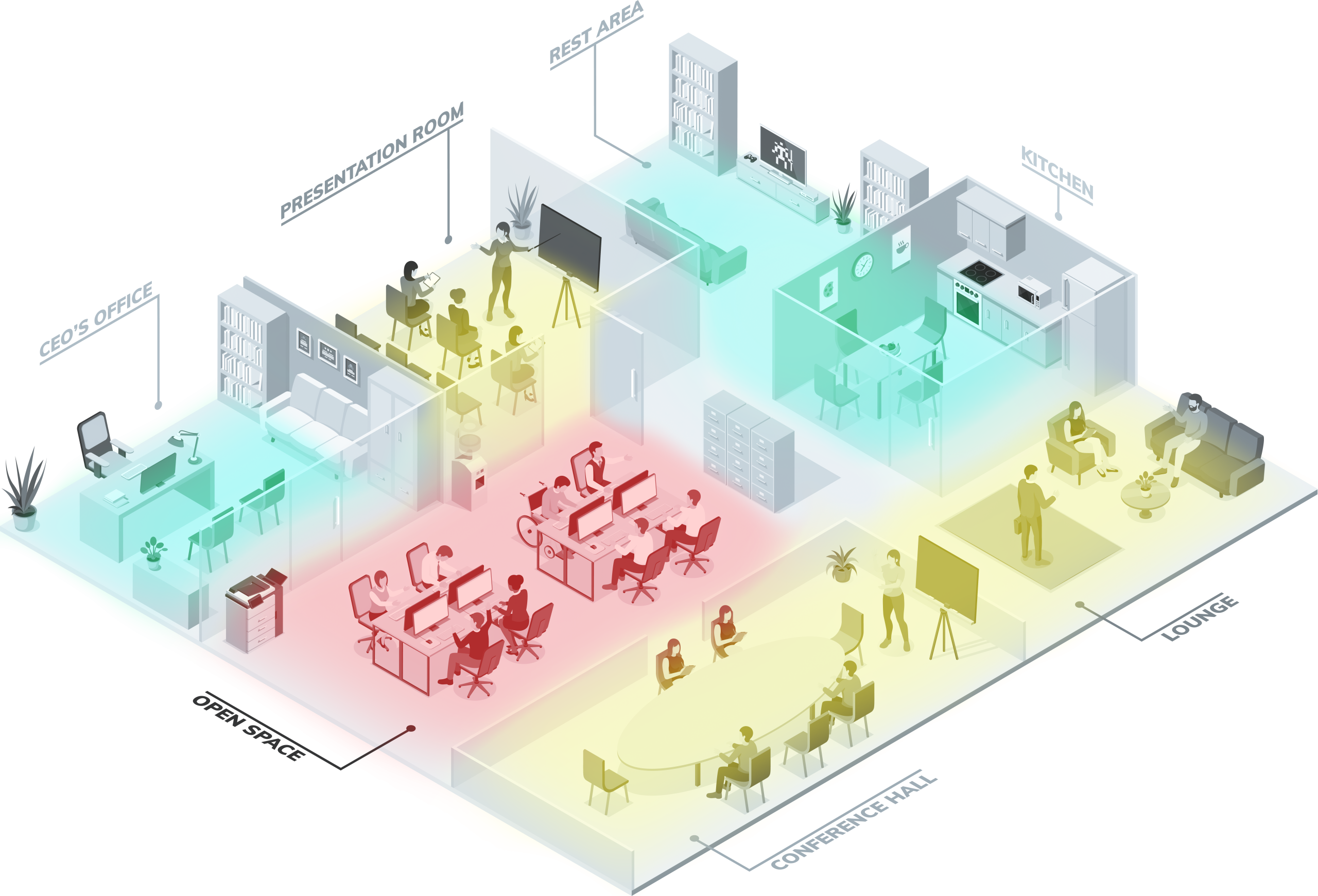
- Smart Buildings: Real-time occupancy data is used to dynamically adjust HVAC and lighting systems to match the exact number of people present, leading to maximal Energy Efficiency. [1,3]
- Corporate Real Estate: Businesses use it to measure Space Utilization Rates, informing multi-million dollar decisions about floor plans, office capacity, and lease agreements. [1,3]
- Transportation & Public Safety: Systems are essential for passenger flow management, optimizing resource allocation and reducing wait times in major transit hubs. [6]
The ability of People Counting to generate deep, actionable Spatial Intelligence across multiple, high-value verticals solidifies its position as the next massive and enduring trend in the Internet of Things.
Conclusion: the new Metric of the Physical World
People counting has transitioned from a niche retail tool to the fundamental metric of the physical world, just as clicks and impressions are the fundamental metrics of the digital world. The shift from monitoring the environment’s status (air quality) to monitoring human interaction with that environment is the most significant evolution in mass-market IoT.
For network providers, hardware manufacturers, and software developers, People Counting is not just another application: it’s the new anchor for large-scale, high-value, and high-growth IoT deployments. It represents the crucial step where the Internet of Things moves from passive sensing to active Spatial Intelligence.
The Author: Dr. Max Ruffo is a visionary technology leader with over two decades of experience at the forefront of industrial innovation, having pioneered the introduction of 3D printing, civil drones, autonomous mobile robots and LiDAR sensors. Today, Max is dedicated to a long-term mission of building a better world by championing green buildings and net-zero communities.
Web references
References
- MarketsandMarkets. „People Counting System Market Size, Share & Research Report.“ (e.g., Valuation and Thermal Camera data).
https://www.marketsandmarkets.com/Market-Reports/people-counting-system-market-206905443.html - DataIntelo. „People Counter Sensor Market Research Report 2033.“ (e.g., Valuation data).
https://www.grandviewresearch.com/industry-analysis/people-counting-system-market-report - Market Research Future. „People Counting System Market Empowering Data-Driven Decision-Making in Real-Time Spaces.“ (e.g., CAGR and Smart Building driver data).
https://www.linkedin.com/pulse/people-counting-system-market-size-share-scope-trends-lmrke - Polaris Market Research. „People Counting System Market Size Report, 2022 – 2030.“ (e.g., Valuation and ToF data). https://www.polarismarketresearch.com/industry-analysis/people-counting-system-market
- SNS Insider. „People Counting System Market Share & Growth Report 2032.“ (e.g., CAGR, Video-Based Technology, and Bidirectional data). https://market.us/report/people-counting-system-market/
- Maximizemarketresearch. „Real-time People Counting System Market- Global Forecast and Analysis (2024-2030)“. https://www.grandviewresearch.com/industry-analysis/people-counting-system-market-report