
Tired of hunting for a quiet study spot in the library, or arriving at a massive lecture hall only to find a handful of students scattered throughout? Universities are bustling, complex ecosystems, and managing them efficiently can feel like trying to solve a puzzle blindfolded. But what if the campus could tell you exactly what it needs?
This was the core focus of the recent webinar, « Optimizing Campus Spaces: How People Counting Sensors Transform University Facility Management », featuring experts from Terabee, Planon, and the University of Sunderland. The major takeaway? The future of campus management is happening now, thanks to clever, unobtrusive people-counting technology.
The Technology: High Accuracy, Guaranteed Privacy
Terabee provides two complementary sensors to measure human presence securely and efficiently across a campus:
- FLOW Sensor: Measures foot traffic by counting people entering and exiting spaces like entrances, lecture halls, and auditoriums. It uses Time-of-Flight technology to create a 3D depth map to identify and count people.
- OCCUPANCY Sensor: Placed in the center of a space, it counts people present in its field of view (up to about 64 square meters). It uses thermal sensing to identify human presence while rejecting non-human heat sources.
For universities, a key consideration is privacy. Philippe Tatinclaux, Account Manager at Terabee, highlighted that their sensors ensure privacy is protected at the source:
- They do not use any form of video camera.
- They cannot detect any identifying characteristics of the people being counted.
- The logic and processing are done on the sensor itself (Edge Computing).
- The system is 100% GDPR compliant by design, ensuring digital trust from the start.
- The sensors maintain a high counting accuracy of 98% or more.
The Financial Impact: Beyond Operations
While day-to-day operations are critical, Philippe Tatinclaux shared compelling examples of how data drives major financial strategy, moving the conversation from « Cost per Square Meter » to « Cost per Hour of Occupancy »:
- Avoid Multi-Million Dollar CapEx: A US university used occupancy data to prove that existing spaces were underutilized, successfully arguing against a requested multi-million dollar investment in a new building extension.
- Drastic Real Estate Reduction: In Sweden, Akademiska Hus used foot traffic data to rethink office allocation. By switching from permanent individual offices to shared spaces based on actual usage, they reduced the required office spaces from 748 down to 432: this is a massive 42% reduction without compromising user experience.
A Case Study in London: Data Driving Decisions
Sarah Morgan, Business Systems and Information Officer at the University of Sunderland, provided a real-world example from their London campus in Canary Wharf. By using these sensors and integrating the data into Planon’s IWMS (Integrated Workplace Management Software), the university achieved:
- Solving the « Ghost Class » Problem: One of the most powerful insights came from comparing three data points: Timetabled Capacity vs. Swipe Card Entry vs. Actual Sensor Count. This allowed the university to identify « ghost classes »: rooms that appeared booked and attended (via swipe cards) but were physically nearly empty!
- Better Space Management: Operational staff gained 24/7 occupancy data to make data-driven, evidence-based decisions about teaching space organization.
- Cost Savings: The system replaced costly annual surveys (circa £10k each) that only provided a limited data snapshot.
- Sustainability: Data is used to integrate with the Building Management Systems (BMS) to automatically adjust heating, cooling, and lighting, creating a more sustainable building.
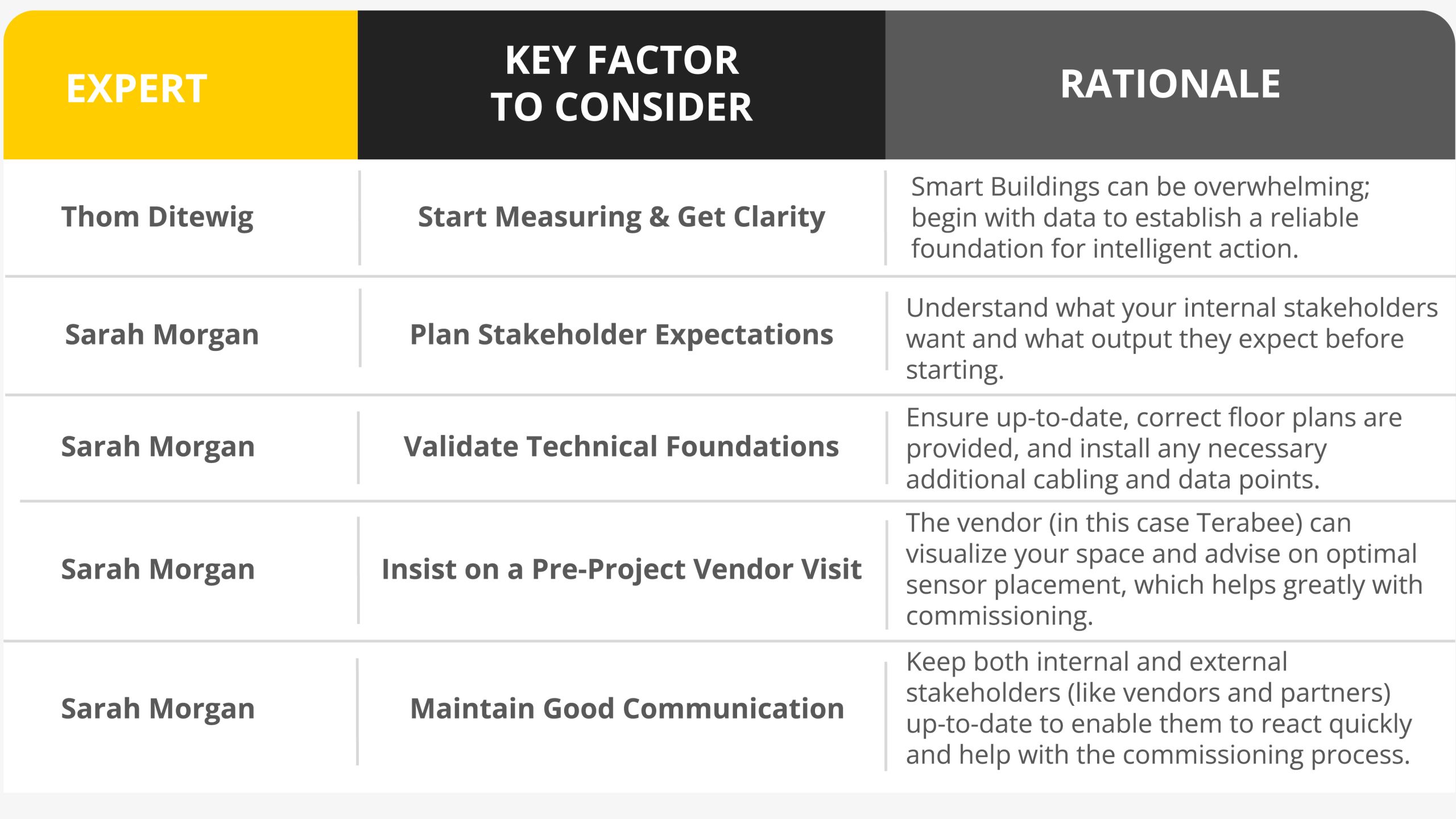
The 5 Top Tips for deploying correctly a Smart Campus Project
Closing out the discussion, Sarah Morgan and Thom Ditewig of Planon offered essential advice for other universities considering a similar project:
Conclusion
The ultimate message is clear: by using smart sensor technology, universities can move beyond guesswork, optimize their significant real estate investments, and create a better, more responsive environment for students and faculty.
The full 35 minutes webinar is available for replay, please contact us for a direct link to watch it.
The Author: Dr. Max Ruffo is a visionary technology leader with over two decades of experience at the forefront of industrial innovation, having pioneered the introduction of 3D printing, civil drones, autonomous mobile robots and LiDAR sensors. Today, Max is dedicated to a long-term mission of building a better world by championing green buildings and net-zero communities.
References & Further Reading
- McKinsey & Company: « The infrastructure moment: Investing in the expanding foundations of modern society » (September 9, 2025). Read the full report
- McKinsey & Company: « The cost of compute: A $7 trillion race to scale data centers » (April 28, 2025).
- McKinsey & Company: « Digital twins: Boosting ROI of government infrastructure investments » (July 3, 2025).
- Terabee: « Why energy-per-person is the metric the future demands ». Read the article
- Terabee Insights: Articles by Dr. Max Ruffo on Smart Buildings and IoT. View collection