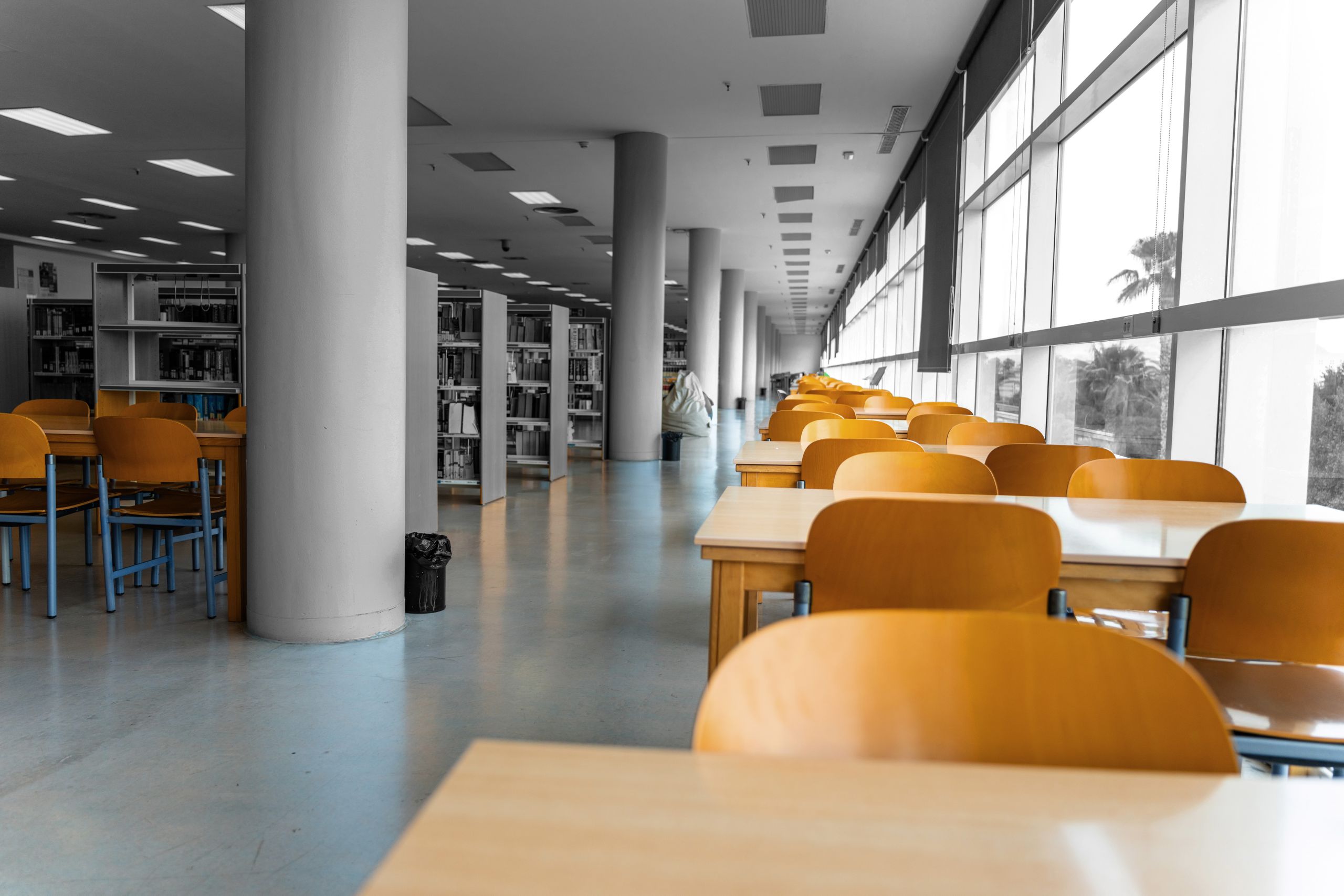
Higher Education is facing a silent crisis: the “Ghost Campus.” Data reveals that while universities continue to build new facilities, utilization rates for existing spaces often fall below 40%. Leading institutions are now reversing this trend, using occupancy data to right-size their portfolios and unlock millions in capital to reinvest in their core mission: education and research.
The "Ghost Campus" Paradox
Universities are unique real estate portfolios. They manage a diverse mix of assets, from massive lecture halls to intimate seminar rooms and research labs, that experience extreme volatility in usage. A lecture hall might be overflowing on a Tuesday morning and completely empty for the rest of the week.
Historically, the solution to overcrowding was simple: “Build more”.
However, in an era of hybrid learning, rising energy costs, and sustainability mandates, this “build-first” strategy is becoming financially unsustainable.
The Swedish Case: A Billion-Crown Lesson in Efficiency
The most compelling proof of this shift comes from Akademiska Hus, the state-owned property manager for Swedish universities.
In a landmark analysis, they revealed that by optimizing their existing footprint and shedding under-utilized space, they could save the Swedish university sector billions of SEK (hundreds of millions of Euros).
- The Problem: Many campuses were operating with low utilization rates, paying to heat, cool, and maintain empty square meters.
- The Strategy: Instead of building new facilities, they focused on intensifying the use of existing ones.
- The Result: Capital previously tied up in facility operations is now being released to fund research grants, student services, and academic programs.
This isn’t just efficiency: it’s a strategic reallocation of resources from “Assets” to “Mission.”
A Global Trend: The 40% Utilization Ceiling
This issue is not unique to Sweden. Data from across the globe points to a systemic inefficiency in Higher Education real estate.
- United Kingdom: A report by the Higher Education Policy Institute (HEPI) has highlighted that some UK university estates operate at utilization rates as low as 25-30% during the academic year.
- United States: Studies on “Space Utilization” often find that while classrooms are booked 60% of the time, the seat occupancy within those booked rooms hovers around 50-60%. This means that effectively, only ~30-40% of the total educational capacity is actually being used.
The Geneva Example: ROI in Conference Spaces
The challenge of optimizing large assembly spaces extends beyond universities. The Centre International de Conférences Genève (CICG) faced a similar challenge. By deploying granular people counting, they moved from static assumptions to dynamic management.
- The Insight: They realized that “booked” did not mean “full”.
- The Action: By understanding real-time occupancy, they could optimize HVAC and lighting, delivering CO2 savings and reducing operational costs.
(Read the full CICG Case Study here)
How Terabee Unlocks This Value
You cannot optimize what you cannot measure. The foundation of the Akademiska Hus strategy, and any successful space optimization plan, is Ground Truth Data.
Terabee provides the sensing infrastructure that makes this possible. Our Time-of-Flight (ToF) and thermal sensors are uniquely suited for the Higher Education environment:
- Privacy-First: Universities are sensitive environments. Our sensors use non-optical technology that counts people without capturing faces or personal data, ensuring full GDPR compliance and student trust.
- Lecture Hall Accuracy: Counting 300 students in a tiered lecture hall is technically difficult. Terabee’s advanced algorithms are designed to handle complex, high-density crowds with precision.
- Scalable ROI: Our solutions are designed for broad deployment, offering the cost-efficiency needed to cover not just one building, but an entire campus.
Conclusion: The Most Sustainable Building is the One You Don't Build
The greenest and most profitable building is the one that already exists. By increasing utilization rates from 30% to 50%, a university can effectively “create” new capacity without pouring a single cubic meter of concrete.
The billion-crown savings in Sweden are just the beginning. The opportunity for Higher Education globally is massive, and it starts with a simple question: How are we actually using our space?
The Author: Dr. Max Ruffo is a visionary technology leader with over two decades of experience at the forefront of industrial innovation, having pioneered the introduction of 3D printing, civil drones, autonomous mobile robots and LiDAR sensors. Today, Max is dedicated to a long-term mission of building a better world by championing green buildings and net-zero communities.
Source of information/data
People Flow Counting
- Definition: Tracks the movement of individuals through defined areas, focusing on direction and volume over time to understand how people navigate a space. Aims to count individuals passing through entrances, exits, corridors, or passages.
- Operation: Relies on technology that can detect and differentiate movement direction. Terabee’s systems utilize Time-of-Flight (ToF) sensors for accurate individual tracking and detailed flow data, including direction. Video analytics can also identify movement patterns. Terabee’s FLOW and FLOW M products exemplify flow counting solutions.
- Installation: Typically placed above or at doorways, entrances, exits, corridors, or passages. FLOW M is suitable for narrow passages (up to 0.9m), while FLOW covers entrances up to 3.4m, with the possibility to combine multiple units for wider passages (up to 15m).
- Applications: Understanding entrance usage, assessing traffic, gaining insights into traffic patterns, enabling space occupancy analytics for large areas (by aggregating data from multiple entrances), managing congestion, and potentially triggering alarms during events like evacuations.
- Terabee Technology: Employs Time-of-Flight (ToF) 3D sensing. This technology uses infrared light to create a 3D representation of movements and recognizes general shapes for accurate counting without capturing personal details. It utilizes low-resolution ToF sensors, not cameras, ensuring privacy.
People Occupancy Counting
- Definition: Focuses on detecting and counting the precise number of people present within a specific area or room at any given moment. Well-suited for semi-static situations.
- Operation: Terabee’s devices use ultra-wide thermal imaging. This technology maps temperature patterns using passive infrared to distinguish between people and objects. Accuracy depends on software that can filter out non-human heat sources. The device counts individuals by sensing thermal signatures with low-resolution images and offers multi-zone counting, monitoring up to 8 independent zones within its view.
- Installation: Typically installed centrally within the area or room being monitored.
- Applications: Determining the number of people in a room, obtaining multi-zone occupancy data for various spaces from meeting rooms to large areas, managing small spaces (meeting rooms, offices, bathrooms), and large spaces (public buildings, open-plan offices, coworking areas). The data informs better business decisions, optimizes space utilization, streamlines building operations, manages space, and optimizes spaces.
- Terabee Technology: Utilizes thermal imaging. This technology detects thermal signatures and does not use RGB cameras, ensuring GDPR compliance and privacy. It functions effectively in low-light and complete darkness.
Key Differences Summarized
- Focus: Flow counting emphasizes movement and direction through passages, while occupancy counting focuses on the number of people in an area at a specific time.
- Placement: Flow counters are generally located at entrances, exits, and corridors, whereas occupancy counters are placed centrally within a room or area.
- Technology: Terabee’s flow counting uses Time-of-Flight technology, and its occupancy counting uses thermal imaging.
- Application: Flow counting is used to understand traffic and movement patterns, while occupancy counting is used to know the current number of people in a space and manage that space accordingly.
Shared Characteristics
Both technologies offer high accuracy (over 98%), are designed to be GDPR compliant due to the technology used (no cameras), are platform agnostic (data can be sent to any server), and do not require subscription fees.
Complementary Nature
These technologies are often used together, with flow data from multiple entrances being aggregated to calculate occupancy for large spaces. Terabee provides both types of solutions.